Showing posts with label design management. Show all posts

Monday, 30 March 2009

Has Design Thinking got a problem?

Came across this piece on Sam Ladner’s blog 'Design Research', talking about Design Thinking's Big Problem. Sam says

'So-called “design thinking” is the new It-Girl of management theory. It purports to provide new ways for managers and companies to provide innovative, creative solutions to old problems. But design thinking alone will not solve these problems because a lack of creativity was never the issue.


The real issue is one of power.

[...] '


I am not going to say that I totally agree with Sam, but I like the way she talked about power, as it seems to be something designer try to avoid talking about. Designers love creating, some of them love thinking as well. The power of creating is so familiar to designers, that they don't see it anymore. I came across service designers talking about change people's mind or people's perception of problem solving and being creative, surprisingly, few of them mention power. Designer holds the power - the power to change people's mind simply by amazing them with the process of creating, by getting them involved in the journey of discovering the stories of a product or a service, by sharing tool to create the life they wanted. It may not be hug step forward but at least they nudge - small change make big differences. But somehow the recognition of such power was often underestimated by designer themselves, a strategic approach to claim that power, therefore, gets neglected along the way.

Wednesday, 4 March 2009

a holistic view for (service) design team

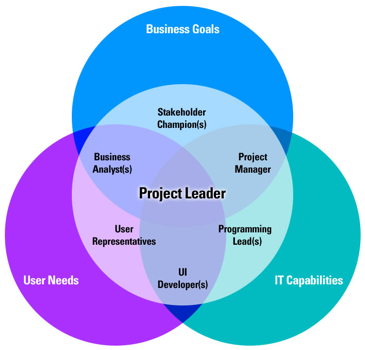
image from Boxes and Arrows

After reading Joseph Selbie's post 'Bring Holistic Awareness to Your Design' on Boxes and Arrows, I quickly made this graph here and start to wonder what is a holistic view for Serivce Design team? What's interesting is that in Joseph devide the role in the design team as Stakeholder Champion, Project Manager, Busines Analyst, User Representatives, UI Developer, Programming Lead. Although Joseph is talking about using user-central approach in web designing, I can instently see characters being reflected in many other design practice that uses a user-central approach...


What in fact bugs me a bit is the right corner circle, and I wonder if that is more of the role that service designer will play as facilitator/navigator rather than as a technology expert. But then I add on 'tool' here... in many cases service designers act as the observer or the researcher using enthnographic tools, but they also act as visual tool creator as well, eh, well that kind of fit back into the facilitator's role, isn't it? I am a bit confused here, and wonder if any of you guys has an oppinon on it?

If we step back and have a look at the 'holistic picture', we might be able to get a sense of the wholeness of all three parties. This model can be an interesting starting point to interpret the dynamic roles of people who are involved in a design project - that many of them play multiple roles at different stage or even simultaneousluy. Whomever is involved in a process at a certain stage is there for a reason, they either has certain knowledge, skill or technique to contribute, or can be benefited from the participation. Design process is often an intensive knowledge exchange, even knowledge integrating process where designer often achieve a certain level of 'inaugurative learning' (Jevnaker, 1993) with the client. So in Service Design, firstly, what is the definition of a design team? What do service designers benefit when people are involved in a project? How they make the decisions of when certain stakeholders should be getting on board, when to leave them aside? What communication techniques are used if team members come from a different background and has different purpose to join the project?

Thursday, 15 January 2009

Three questions to the Service Design world

I proposed three questions as the conclusion of a conference paper to D2B2 in Beijing, and the paper is now going through the reviewing process (fingers crossed for me~). Well, I am not going to bore you with the literature review blah in the paper. In this post I only put forward the three questions to the Service Design world - mainly from a management perspective - and my thoughts for you to comment, advise and criticise. Happy reading :)

Question 1: How do we change our understanding of the design process in Service Innovation?

Traditionally, design processes were modelled on practices that create tangible objects such as a building, a product or an advert. Different theoretical models highlight slight variations in the stages, but the final outcome is always a synthesised plan that goes straight into production. The uniqueness of service design is that the design outcome is a living system that evolves over time as a result of rich human involvement. The distributed pattern of Service Innovation suggests that the result of the design process is open to future changes. The design outcome is not a solution to a certain problem, but a starting point for stimulating more innovations in the service system. This ties service design process closely towards concepts such as Open Innovation and knowledge diffusion science (see E. Rogers).


Question 2: What are the designer’s new roles while working with multiple stakeholders?

For service designers, working with multiple stakeholders acting as silent designers brings difficulties and opportunities to the development of new types of design practice. The service design practitioners in the field nowadays are mostly from a production design, interactive media design or a marketing related background. Therefore, for them to work in a service organisation, service designers are often facing questions such as: where are the hidden silent designers in a service system? What kind of specialized knowledge do they have that can be beneficial to designers? What kind of tools and methods can design provide to unlock stakeholders’ creativity? How do designers work beyond boundaries for collaboration?

Current service design practitioners use visuals and prototypes to interpret different stakeholders’ languages into a vision that everyone can use to relate themselves to the design process. However, they should be aware that a service system will have to be able to self-recover and self-improve after the designers step away. Therefore, service designers, rather than simply the creators of a system, have multiple roles. They are the explorers in discovering customer experiences and also the communicators of its complexity. They are the negotiators of value and the mediators that bring different stakeholders together. Most importantly, as members of a profession with a long history of employing creative methods, service designers become the ideal people to unlock the power for innovation within the organisation at all levels. Working with multiple stakeholders, they have the responsibility to turn the silent designers into active designers. This role of facilitator in organisation environments requires not only visual communication skills but also some basic understanding of ‘empowerment’ – a concept often found in power discourse, social psychology and even philosophy (see M. Foucault, Mary Parker Follett ).


Question 3: How would design’s value be recognised and accepted by other disciplines in Service Knowledge?

With a general recognition of the economic and social value of service, many other disciplines are also conducting new research and concepts in service related issues. At the same time, the awareness of building a multi-disciplinary service community has increased within service science, management and engineering (SSME). At the 2007 AMA Frontiers in Service Research conference, Epworth et al. used the metaphor of a ‘big tent’ that brings service science, management, engineering and art together with a central ‘tent pole’ of the service customer (see Fisk and Grove, in press).

Service designers, with special values to bring to this process of knowledge sharing, should be encouraged to get involved in multi-disciplinary research and practices. At the same time, design education should take the responsibility of introducing service knowledge to a future generation of designers. ‘T-Shaped’ design graduates with skills in design expertise and with a business vision in mind will be capable to work collaboratively with other people in multi-disciplinary teams to share the value of creativity.

Wednesday, 10 December 2008

management innovation


“why can’t we bring as much innovation, adaptation, and engagement to our organizations as we do to our development of products and technologies?” Gary Hamel asks, in his The Future of Management. When it comes to innovate in a process that is not centered in a R&D group, the power of innovation gets lost in the day-to-day 9-5 operation. Same challenge to service companies, how to keep the creative spirt in the organisation during the continous growth of service systems? The answer is to do it with its people. By people I mean everyone involved, not only the top managers or service managers. The power of innovation, the people-centered approach, the design toolkits, should be deliveried to the contact employees, the customers, the accountants, the external enterprises, the logistics, the part-times, the full-times, the I-have-no-time-being-creatives! Engaging people in the design process is just one part of the job of a service design manager, there is a even more challenging part: to keep that engagement in the organisation and let it grow with the service system.

Thursday, 4 December 2008

power and creativity

"... no one can give us democracy, we must learn democracy. To be democrat is not to decide on a certain form of human association, it is to learn to live with other men..." by Mary Parker Follett (re-print by Graham, 1995)

Monday, 1 December 2008

the rising far east


Divya, a former MDes took a senior design position in the first experience design consultancy in Inida - Idiom. The company has been using customer experience researches as the base of their design practice. Most of the clients are in the field of retail and identity. You will be able to find couple of pages in their webspace talking about their Design Philosophy and about Desig Thinking in Inida.

In China, the next Design2Business Conference in Beijing will be 'looking at evolving frames of reference in which both Asian and Western organisations are grappling with new concepts in product and service design.'

Clearly, the rising design force from Asia has been quickly developed with the same quickly boosting economy and the fast growing marketing needs. How will the new generation of Asian designers be able take the chance of the changing global evironment and, in the same time, develope new insight within their unique local economic, cultural and social environment in their design practice?
Coincident or not... the Design Management Journal published this November has a special issue discussing the topics of 'Managing Design in Global Environments'. In this issue Song and Chung (from KAIST South Korean) talked about how CEO can play a role in Design Management exercises and clearly suggest the importance in approaching design practice with a close cooperation with the hight level management roles. Griffith and Tan discribed how the western design methodologies do *not* work in the Asian market - the 'Simple Complex', as what they call the situation.

the Economist, again, 'predict' the world power tranfer from the U.S. and the European countries to the other countries like China, Russia, India and Brazil in the lately published 'the world in 2009'. In this coming new year, every individual, organisation, country in this world perhaps will have to work out (then adjust again and again) where they can fit in this changing world, so do us designers.