Some materials from me if you are curious what happened:
Thursday, 26 November 2009
Nordic Service Design Conference 09
Some materials from me if you are curious what happened:
Monday, 23 November 2009
sweet sweet gifts
To be honest, I was quite impressed by the organisation of Nordic SD Conference - received this little pack shortly after arriving at the hotel. Couple cute gifts from the organisor, including a pair of over-shoes to 'protect your favourit e shoes regardless of weather conditions' (shame that my Timberland seem too big for them...) and a set of design cards around touch-points from the AT-ONE project.
It seems that card making is the new 'black' in Design now. we all know the famous IDEO cards, as far as in Service Design, I know of two other sets of cards. One is the SILK method cards made by Engine with Kent city council. The other one was Lauren (Redjotter)'s Master project: Making Service Sense, a set of postcards of SD case samples. Both brilliant projects - I would love to see more likely projects, and also see these methods find their way into organisations and make tangible differences. It would be great if the use of design card becomes as normal as using SWOT Analysis. well... if you know of any other similar card sets, I would love to hear from you!
I mean it's a good thing. It's a sign that designers are preparing to share the authority of being the 'gifted ones' with more people and moving into a facilitating role in order to encourage innovation at larger scale, well and democracy as well. I consider it as a sign of this profession becoming more and more matured, and am happy to see that Service Design is honest to what it claims to be: co-design, and empower others.
Really look forward to tomorrow, yet, have to prepare for my own speech first... left the speech notes in the UK, so gotta work from scratch again... Well, let's enjoy the next three days!
Sunday, 22 November 2009
two questions to Service Designers...
1. How far should service designer go in service implementation?
For my research, I interviewed a couple of service designers. It seems that not all designers actually are actually designing the touch points or carry out training workshops. Many service designers work only in the research stage of a service development project and then hand it over to other people - either the client or the so-called ‘traditional’ designers - to deliver the implementation stages.
I had an interesting conversation with one of my participants who was a practicing service design about this. It seemed that the designer was fairly happy to stay as a mainly researcher role rather than getting into the details of designing the actual touch-points or running trainings for the client. Of course I am not saying it represents what all service designers are thinking, but it did make me think how far would and should service designer, as a professional, go in service implementation?
Hypothetically, there is a role of actual producing in service development, either producing the actual touch-points (physical products or it is a piece of software) or producing the process of implementation details (the criteria of the service or a roadmap of how change would be carried out in the organisation). But in the case studies out there, I did not see a whole lot of stories about how the implementation is carried out. So why? Well, it can be that service designers do not consider the producing as Service Design job, even though they sometimes does it, they would rather let ‘traditional’ designers to do it. Or… they cannot do it, because they do not have the skill to produce. Let’s be honest, roadmap of organisational change is not really in designer’s skill set, isn’t it? Of course there is a third option that the client does not want designer to be involved in the implementation – if so, how do we overcome it?
So, my question is… if you happen to practice as a service designer, how far do you normally go in service implementation? Or, how far you think service designers should go?
2. How is Service Design related to knowledge creation and diffusion?
One thing I often hear service design say about their project is to ‘change people’s perception of service’. Service, like branding, is socially constructed in people’s mind.
Developing a new service obviously involves creating new recognitions of that service among different stakeholders, and new knowledge about how to delivery, market, operate it. And that knowledge has no value unless it is diffused to all parts involved in day-to-day service delivery. After all, designers are not the ones who handle the users or supply materials/information in the backstage. Then the ultimate goal of designing service is actually about creating and diffusing the knowledge about a new service. Visual methods, blueprints, workshops, whatever service designers use, they are just means to let the knowledge flow.
So… it seems that Service Design is actually closely related to managing knowledge creation and diffusion. But so far, Knowledge Management does not seem to be a popular topic in Service Design... I found Debowski’s Knowledge Management theory interesting. It suggests that building capacity in knowledge development can be influenced by social capacity (e.g. organisational culture), technological skills (like IT systems), leadership (vision, and strategic stuff) and project/problem-based learning (that involves designer and all stakeholders I suppose).
Have any of you guys used any similar structure to analyse or plan your Service Design projects? Say, like evaluate or predict the social capacity of the service provider while putting together the blueprint?
Or… maybe you guys have some practical tactics to go about understand knowledge creation and diffusion in Service Design process. Care to share the trick please?
Thursday, 22 October 2009
a heaven of design concepts - beautiful and insightful
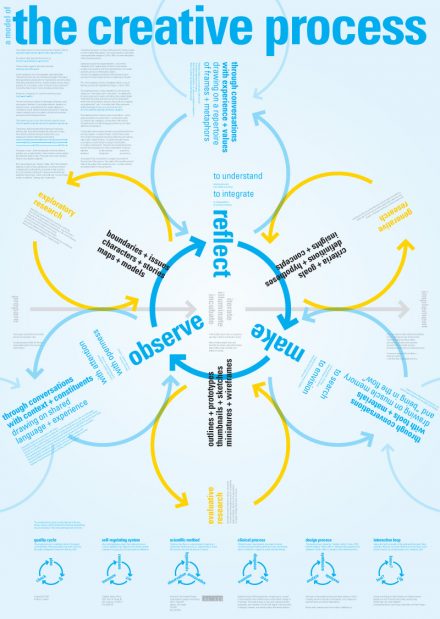
http://www.dubberly.com/concept-maps
I rememeber years ago I came across a report produced by Debberly Design Office (ddo) on design process and was impressed by the nice way they articulated the evolving complexity embedded in different proposals of design process.
Guess now I am off to have a close look at all these diagrams - have to say as an information architect I love diagrams ;-)
By the way, this one is my favourite - was looking for something that present a rather distributed pattern for design process, and it's there~ right there~
Thesis 3.0 ?!
Any suggestions on how to do it? I am thinking of skyp interviews or email interviews... maybe kidnap some people on SDThink night on 19th Nov will be another solution ;-) By the way, anyone who is going that night (and perhaps want to be kidnapped as well...)?
Good news is that the categorise are coming together - slowly... my god... time, time, time...
Last week, I made a revisit to the thesis structure and here we go, a thesis 3.0:
Saturday, 10 October 2009
Interdisciplinary Discovery Through Design
Amongst the five project presentations in the morning - all interesting projects - I was especially impressed by two.
The BikeOff project was based on the idea of design against crime. The project looked at design for bike riders' security issues, and developed ideas that can go on to further commissions in manufacturing. At first glance, it was a typical multi-disciplinary design project with inputs from crime scientist, designer, engineers, social scientist and many other extended stakeholders. What I find interesting is the way the project was managed with what they called 'An Open Innovation Research Approach'. The project demonstrated how using overlapping research processes carried out by different stakeholder groups achieved the transformation from multi-disciplinary to inter-disciplinary, where the hybrid ideas start to emerge in prototyping stages, and also the design outputs became more diverse. Especially the approach was good at efficiently develop product (perhaps services as well) to explore unrealized marketing needs, rather than develop predicted outputs as planned in the first place. Guess this is what was missing in many NPD and NSD literature. We were taught to be so busy controlling and defining the process of design that it becomes so easy to forget to enjoy the discovery, the iterative exploration that leads to new territories.
The other one was the Design for Services project presented by Lucy Kimbell – I believe most of you guysa are familiar with this project. In her presentation, Lucy talked about the designer’s unique approach to generate knowledge through practice, which was not really discussed much in other of her publications. Although I temporary moved my research focus a bit away from the whole knowledge creation literautre, it was still nice to hear other's reflections on a similar subject.
We were then asked to discuss in groups and to fill in paper that describes the contribution of ‘design researcher’ – and somehow this is a confusing term. As some people in the room came from an academic background, thus researcher means ‘people who studies design’, but others (like our group) saw the role expended into the researchers who actually worked in design processes and contribute to the design outcome. If we look at the five projects presented in the room, all reflected a part of knowledge on the ‘study of design’, but most of these learning come from actually conducting the design practice. So did it mean ‘design research = design’ then?!
Out of all the answers we put on the paper, I personally found ‘giving people a voice’ is the one that capture design reearcher's perspective the best. As it could suggest the use of visualisation but keep the empathy and the central focus on people (either as user, stakeholder, or research subjects…) When one of the participants in the final discussion part pointed out that ‘imagination or creativity’ is missing from the key skills of designers. Is that we are just too close and we don’t see it anymore? No, I don’t think design profession is all about creativity or imagination. Everyone is creative and imaginary if they have the confidence and the voice to communicate, to share, and to impress. The value many of the pioneering designers in the field – a lot of them in Service Design but also many from other design areas – is to give people the voice and the confidence to be creative and imaginary so that they can see, create and implement solution for their own problems.
One of the highlight of the event to me, personally, was actually meet many of old friends who share a similar interest in Design and Research. Lauren Tan, a PhD in Service Design as well as good friend also blogged her thoughts on her blog. A pleasant surprise was to meet Ahmad Beltagui from Nottingham University Business School at the event, who then introduced me to a really helpful paper on 'What is not a Grounded Theory', which motivated me to kick off the Research Design chapter this week. Sometime, I do wonder why we keep going all over place to attend these events and perhaps we thought we know the presentations so well already. But what I often found out is that when a group of people with a similar interest were put in a room under a certain task, good stuff do come out from somewhere we didn’t expect.
... more picutres on Flickr ...
Friday, 11 September 2009
Take a bow
I was standing in the crowds in the Lower Gallery when Lily went up to me and said: 'would you like to work for MDes as a teaching fellow?' I said 'yes' - which is one of the best decisions I have ever made. That was my own year of graduating Master of Design, and the night was the Master exhibition openning. I was simply enjoying the celebration and looking forward to the back-pack trip around Europe the next week. At that time, I perhaps didn't yet realize that what happened after I got back to Dundee was better than the most amazing journey I have ever dreamed of.
It was exactly three years ago.
Tonight I am witnessing a new group of 13 students enjoying their celebration and planning for their next step. So am I. This is my final week of being the ‘teaching fellow’ of MDes at the University of Dundee. Again I am at the point of facing a new journey in front of me. I am so happy that I still have courage to step into all the unknowns of my life, to make changes and to look forward to adventures.
Master of Design has been and will always be part of me. I had truly enjoyed every minutes spent with my brilliant colleagues and my inspiring students. I hope that they had enjoyed my company as well.
It is the time, the time to take my bow and start a new journey, maybe a completely different one but I know I will enjoy it just as I have enjoyed this one.
the end of design? the re-brith of design!
Yesterday we had a truly inspiring lecture from my brilliant colleagues Tom Inns and Mike Press in University of Dundee, as part of the Master of Design student project exhibition opening.
Tom took us back to his river of Design History. He also predicted that the sunny but highly pressured area of emerging design archipelago (service design included of course) which looks at real issues in our complex life is suggesting a re-birth of Design as a discipline. The world is witnessing an revolution brought about by new ways of communication, of living with the natural and artificial environment around us and of operating corporate, thus new generation of designers are exploring their ways into the challenging but exciting future – the best examples of which is right here on the Master’s exhibition.
Mike suggested that we were here not looking at the end of a master programme, or the end of design, but were celebrating the new beginning of a different journey ahead of our Master graduates, as well as us as designers and design researchers. Design is about the vision, the imagination of what the world was like, should be like and could be like. Mike introduced some of his design heroes (well, in fact most of them were not really recognized as ‘designers’… ) who believed that design is valuable to improve life by different means of, for example public services, engagement and empathy. ‘Nothing was too good for the public’ as Mike stated in his speech, there was a time when designers and artists were actively engaged in communities in public services to deliver effective, efficient and empathic solutions and motivations. It is time we look back upon these heroes, and set out a new phase of design which described as ‘Social Design’ by Mike. How do we create alternatives to social issues? There were principles suggested in last night’s presentation as:
- Empathy and user-centred,
- Co-creation and co-design,
- Service focused,
- Cultural inclusion,
- Socially engaged,
- Empathasis on well-being, and
- Connected.
These principles as well set out the guidance of the 13 projects undertook by the Master of Design students for the past year. If you are interested in having a look at these projects in more details, please visit http://www.dundee.ac.uk/djcad/mastersshow/design.htm
As well for more information about the Master of Design course at the University of Dundee, please visit http://www.masterofdesign.co.uk/
The one-hour lecture was videoed and it is expected to be made available online soon. I am providing a lecture note just to easy your waiting ;-]