Thank you for all these years' commenting and supporting, I would love to see you at the new place :)
Monday, 20 September 2010
moving home
I have moved my blog to a new host for www.designgeneralist.com, so I will stop updating this place.
Thesis published - practices and principles in Service Design

After three years of hard work and countless editing, finally, my PhD thesis is published in the form of a book via lulu.com publication.
"How do service designers manage multiple stakeholder involvement in complex projects? How do they generate knowledge and disseminate it? What is a Community of Service, and why is it important to the future of service design practice? In this book, based on her PhD thesis, Qin Han examines the practice and theory of service design, identifying three common design approaches to stakeholder management, and the knowledge that service designers need to develop projects and groups. This ground breaking study of the relatively new discipline of service design offers a useful summary of existing literature from related fields and places it in a design context. Dr Han concludes with important proposals for the future study, practice and teaching of Service Design. A must-read for practitioners, academics and students of design, business and management."
You can order the book directly here for £24.65
Free summary for downloadAlso for those who don’t have the time to read through the whole book, I provide a summary for download here <- it doesn’t cost you anything but a tweet, so please enjoy the work and spread the words.
Thursday, 26 August 2010
information is beautiful
Oh-yes, information is beautiful.
Find this beautiful site from David McCandless, a London'based writer and information designer. Another inspirational place for diagram lovers like me.
And also, if you are a doctor who fan, than maybe want to contribute to his new work on visualising doctor who time travelling here.
Tuesday, 17 August 2010
favourite visual research techniques

I was invited to write something about my research for the Design Studies blog at the University of Dundee. So I decide to share some of my favourite visual research techniques with the smart kids at Dundee. This leads to a guest blog post 'Giving Research a Design Twist'.
Go and have a look at their blog because it has a rich resource of design in all contexts: design research, craft, creative enterprise, social innovation... anything you can think of! You may find something interesting for you as well...
Sunday, 15 August 2010
The service design of proposing a marriage

A girl friend of mine told me that a boy asked her for advise on what kind of engagement ring he should get to propose to the girl he loves. And my friend says, ‘it is not about the ring, you boys just don’t get it, it is about the presenting of it.’
Guessing what a girl wants has always been a bit of a mystery to most of the boys. It takes more than a good guess. I suppose many service designer/manager may share similar experiences, you can get statistics about trend, taste and fashion of any ‘thing’, but the difficult part is to deliver the right ‘thing’ to the right person at the right time with the right feeling. What you need is to get advice and inputs from other people. In this case, parents, her sister and girl friends are all V.I.P stakeholders. In some scenarios, blessing or permission from parents are important to this marriage you are proposing. And girl friends will be able to provide useful suggestions from a girl’s perspective, and even probe information for you. Consulting married couples may provide good case studies as well.
And when it comes the big moment, emotions are even more important than the rock (I know the rock costs a lot, but hey…) A sense of commitment is essential, and most of the girls would love to be surprised (just a little bit). After all, it is often the emotion that gets the girl, not the ring. Or shall I say, it is the ‘service’, not the ‘product’ that gets you the big ‘yes’.
Thursday, 24 June 2010
Designing a better world at Northumbria
Last week I went to Newcastle for this one-day conference to pick up some tips on how to design a better world. 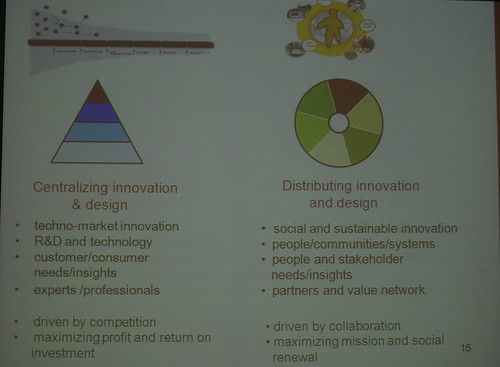

The opening session was really about a discussion of what ‘better’ means to different people, I particularly like Julia Lohmann’s idea of ‘nothingness’, where people have more time to think and enjoy life rather than busy getting it stuffed by stuff…
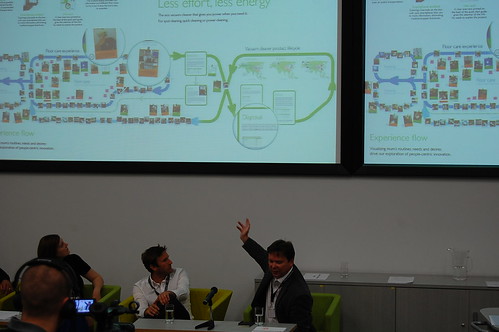
I am rather impressed by the two speakers from Philips. Gavin Proctor talked about their extended product life cycle that goes beyond the line of consumption, but into disposal and recycle of Philips product as well.
The closing keynote was from the brilliant Josephine Green, who previously worked as the Senior Director of Trend and Strategy at Philips Design. She took us through the change we are experiencing in terms of social structure, or in her words ‘from pyramids to pancakes’. Couple of key characters of the pancake society is around the distributing innovation, collaboration, community and sustainability. Well, according to my knowledge, you can find some related arguments in Zuboff’s Support Economy and Gary Hamel’s Future of Management – both talked about the power shift towards stakeholders and their role in open and social innovation. It is quite inspiring to see how international company that previously has a reputation in manufacturing, such as Philips, stand up and talk about what social change means to them and how they face the challenge to move ahead.
And for fans of social innovation, here is a link from her presentation regarding some tools and methods for social innovation that may interest you: www.socialinnovationexchange.org
There was a concern expressed at the conference regarding whether it is too optimistic to this bright future Green presented, as the environmental scientists are basically telling us it’s too late. Well, wonderful Ms Green replied ‘it is our moral responsibility to keep optimistic in difficult times.’ and she also said ‘Life is a bitch.’ – wise words!
Interestingly, the next day of the conference, I found this rather odd little box outside Waitrose in Newcastle city centre full of green tokens. So it was the Community Matters Theme from Waitrose. They ask their customers to help them choose how much they should fund in community projects, so their investment is driven by community for community. Customer who shopped in the store were given a green token to vote for the community project they would like to support, and then Waitrose will invest money in these projects according to the result of the voting. A rather engaging approach to present community development to Waitrose's customers, don't you think?
By the way, I voted for the wild animal one, and then an lovely lady passed by me, put her token into the same box and told me 'nice choice~' - haha!
So supermarket is catching up by placing themselves as an active part of the community and support local development. Why don't we have Waitrose in Dundee? Can we vote for that as well?

Friday, 11 June 2010
Hello again
It was not my intension to leave this space empty for such a long time, yet, my thinking has not stopped during the absence of blogging. In stead, I have reached some really interesting findings of my research, and glad that the challenging job of writing and reflecting the three-year journey has gained some positive feedbacks.
Yesterday I went to London and visited Participle’s little but busy office at Tanner Street. Participle has a clear vision that challenges the current state of public service and policy making. One of their most famous projects might be the Southward Circle, a social enterprise aims at solving problems for the aging society using the power of local community. I was delightfully surprised when I heard that they actually live prototype services in their little office – turn their office into the headcounter of a social enterprise for a good couple of weeks to find out what’s working and what’s not. It is exciting just to imaging live prototyping a service rather than writing it up in a report or business plan (not saying writing is not important but you know what I mean) This reminds me of We Are Curious’s method of establishing office at their client’s site in order to develop and exhibit their learning with the key stakeholders. Locations for Service Design seems to be a rather interesting topic to have a look at, it does reflects the inspiration of building a community of knowledge around a functioning service system, isn’t it? Maybe someone should collect examples like these and make it a method… how about call it ‘real space for service prototyping’?
Jennie Winhall, the friendly senior consultant at Participle, asked me what do people do with their big thick thesis. I said, well, disseminate it. So here comes the question of how. Getting back to blogging. After the long break it is good to be back and start again with a fresh mind, with a new background (Who wouldn’t love a blue sky?) Also I am preparing some paper for different purpose right now, one about the different aspects of design outcome for Service Design, another one for design education, and potentially another one for designer’s role in change management. But maybe the best way of realizing the value of the big thick book of knowledge is through practice. Here we go, a Service Design PhD looking for a job to make a difference. So if you happen to know of any opportunity to offer, I would love to hear from you.
Monday, 18 January 2010
customer experience touch-point cards

Now let's see what Simon says about these really inspiring cards...
1. Where does the idea of producing touch point cards come from? Who made them? Is there any project context that gave birth to them?
The idea emerged when we started running workshops in the AT-ONE project two years ago. AT-ONE is a project that aims to assist the first stage of an innovation project - the Fuzzy Front End - using service design techniques. In AT-ONE, each of the letters relate to different aspects of service innovation - Actors, Touch-points, Offering, Need, Experience - and we have developed innovation workshops for each letter. As part of the Touch-Point workshops, we found ourselves needing touch-point examples to help with both mapping and analysis work (before a workshop) and for idea generation during the workshops themselves. We started out with lists, then photos and decided that what we needed was a set of cards that could both stimulate new thinking, but also help map out existing situations. When we realised that the conference was coming up, we decided to print up a set for the participants.
The cards were made by Ingvild Støvring and me together, both of us from AHO (the Oslo School of Architecture and Design). She took most of the photos and designed the cards, I created the content list and the tools for their use. We printed at a local printers after trying (and failing) to find a cheap foreign printer.
2. How would you describe the process of developing these cards developed? Were they prototyped or tested?
The development process has been kind of evolutionary over the past two years. We have run tons of Touch-Point workshops together with various companies, and various versions of support examples were developed to help communication and innovation. We have moved from texts to images to the combination shown on the cards. We have also developed several tools to help design teams facilitate new thinking about touch-points, and some of them are included with the cards. So, they have been prototyped several times and improved each time, most recently during our master course in Service Design last Autumn. It seems like the forced association method is the one that the students always like to use. I guess its because it encourages radical ideas and forces you to think in new directions.
3. Who are these card made for? I noticed there are five different ways you suggestedto play these cards, so I guess the card game is designed not only for design teams, would you describe a bit more about the possible situations that thesecards can be used?
The cards are made for cross-functional teams who are at the start phase of an innovation process. When teams come together, there is often an interesting but odd mix of people and varying degrees of design experience. One of the main things that happens in the start phase is team building - finding common ground and pulling together. At the same time, the strategic mandate the project has received is translated into a chosen direction for the project. Its a critical time for the project, since decisions made here have huge consequences for future direction. Hopefully the cards will help the team (or individual members) analyse the present situation (if there is one) and develop ideas for new services or service touch-points. We have tried to design them so that they can be usable by any team member or team facilitator. So far, they seem to work well, and I find myself using them regularly in different contexts.
The contexts for their use are as follows, but we have found that they can be used in other contexts as well.
Firstly, they are aimed to be used at the early stages of the innovation process, the fuzzy front end. This is a divergent stage in a project in which various directions are being explored, and many opportunities are still open. The cards aim to help analysis, reflection and idea generation during workshops in which multiple stakeholders are involved. Generally a design team includes stakeholders from across organisational silos and include a broad set of disciplines. The cards should hopefully assist communication accross these different boundaries, and help create a common understanding regarding various touch-point issues. They also make explicit, what earlier has been up inside peoples heads. This is a common comment about design and its role in process facilitation - the use of images creating a common understanding within a team - and its true. We have found that using the cards helps move the team forwards in a good way.
Use context 1: Mapping an existing situation.
The cards help map out an existing situation. For example, the team can go through each stage of a service (or customer) journey and pick out the touch-points that are relevant at each stage. From this, many aspects can be discussed, such as which touch-point is most important to the customer, which are (maybe) used in sequence, which are most frequently used etc. This helps get the discussion moving around how customers view the service through touch-points, and how they often jump between them. It can also help raise the discussion about who is reponsible for develping and maintaining each touch-point. It is always a surprise for a team to understand that there is often a total lack of touch-point coordination accross an organisation.
Use context 2: Identifying pain points
Once the service journey has been mapped out, then there are loads of things you can do. One of the things we find useful is to identify the touch points along the service journey that dont perform particularly well, and why. This can be a useful means for improving consistency of experience along the service journey.
Use context 3: Whose touch-point is it anyway
One of the things we have found out is that in large organisations, different departments can be responsible for different touch-points. This often comes as a shock to an organisation, but is something that is usually noticeable from the customer perspective. There can be different tones of voice, interaction styles, use of images, typography and especially different terminology. Identifying who is responsible for each touch-point and finding ways of coordinating between them can be very useful. So, what we do is simply to note who is responsible for each touch-point used to access the service.
Use context 4: Touch-point migration
An organisation might get lazy, or might just not have routines in place for updating their touch-points. Over time, a touch-point might become out of date or there could be a better touch-point alternative that can be migrated towards. This is particularly relevant when it comes to use of technology and discussions regarding self service. Going through the touch-point cards can give ideas for new touchpoints and can help map out a migration strategy from one touch-point to another.
Use context 5: Touch-point addition or subtraction
This one is aimed at challenging todays situation by removing important touch-points. Based upon the touch-point mapping, remove the main touch point at each stage of the service journey, and discuss how it can be replaced. Surprisingly, you will find that it can be replaced, and this can give you ideas regarding new facets to a service. It it cannot be replaced, then the team has gained a deeper understanding of the touch-points importance and role. The opposite of this is to pick a random card at each step of the service-journey and discuss how it could be used to improve the service. We have added some specific touch-points for this, such as "service integrated into a product" or "smart phone". This can be a useful task in many ways, particularly to help challenge todays situation, which might have deep historical roots and need updating. Thinking about how an iPhone app could improve the service is never a bad thing anyway.
Actually, a bit of a sidetrack here, but when we started the project we had one card for mobile phone. However, we realised quite quickly that technological development has moved so fast that there are mobile phones, internet enabled phones and smart phones running apps. We had to create several categories of phones, and will probably have to add even more over time, such as tablets perhaps.
Use context 6: Forced association to create new services
This one is a favourite in workshops, even though it doesn't always generate that many relevant ideas. In this task you are forced to create a service based upon random cards: pick two (or more) random cards from the pack and design a service for your client based only upon these two cards. Forced association is a well known technique to force you away from logical thinking, and doing this with the touch-point cards is a good way to force yourself to think differently. Quite often you will end up with useless combinations, but its easy to put the cards back and pick again. Its a fun and challenging way to look at touch-points, and often unearths useful reflections regarding a service.
As you can see, the cards help stimulate both understanding and various kinds of innovations. They can be used for anything from analytical approaches to idea generation to impulsive and radical new solutions, depending upon the project and project context. They can be used alone or in teams, and work well together with clients.
4. Have these touch point cards been used in projects yet? (for example student projectin AHO?) It would be great to have some examples of these cards being used indifferent context or projects.
The cards have been used in student projects and together with several service providers. The project has a collaboration with several organisations in Norway, but two main ones - a large insurance company (Gjensidige) and the National Lottery (Norsk Tipping). We have carried out two iterations of the methods used in AT-ONE per year, so have already run through 5 iterations of the process. The experience so far is very encouraging, and we are in the process of validating the process and individual tools at the moment. This is not an easy thing to do, since innovation is not always easy to measure. Where do ideas come from, where do they go, and do how do they become adapted underway? Is organisational change a more important innovation than the number of ideas generated? Does the focus upon touch-points that this particular tool encourages (there are tens of other tools too) lead to better consistency in a service over time? What we have found is that the tools help generate a lot of ideas. They also help give new perspectives and understanding, and particularly help companies understand how customers view their company through touch-points and over time. So far, we are pretty happy with these cards, and we will definitely print up some more quite soon. In addition, we will make them available as a download on www.service-innovation.org, together with the other tools we are working upon.
If we were to remake them, I don't think I would change many things. There are some formulations that could be improved, and we have only scratched the surface when it comes to how to use them. I think its a good idea to set them free, so that people can add cards and add tasks. In that way they could continually evolve, which would be nice.
( from Simon Clatworthy, 18 Jan 2010)
Subscribe to:
Posts (Atom)